
Co-Creating Psychological Safety
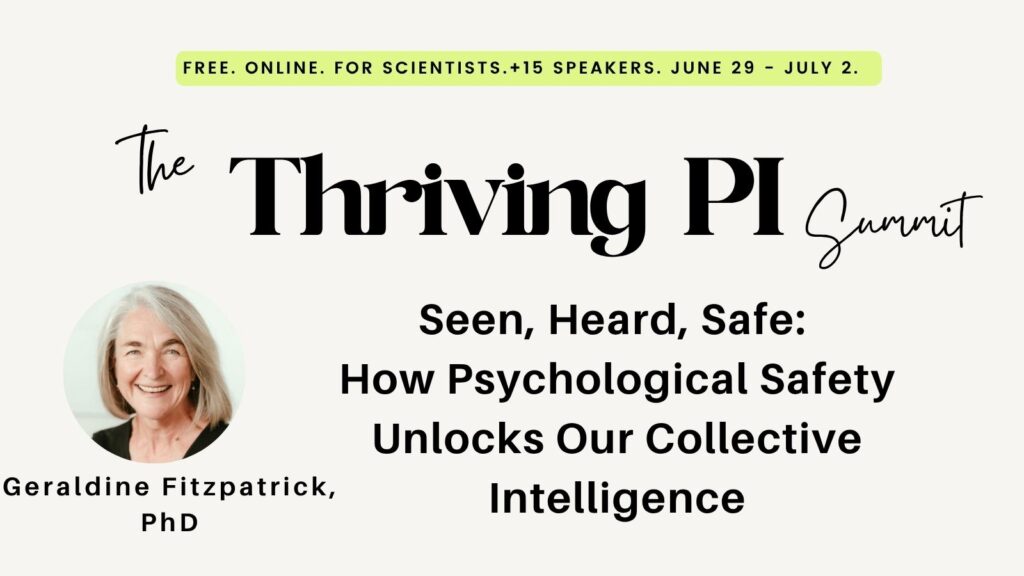
Summary of a talk by Geraldine Fitzpatrick.
Psychological safety is essential for making people feel seen, heard, and safe, and for unlocking collective intelligence. It is foundational for creating great research cultures and for doing good science.
While the concept of psychological safety has been around for a while, it is the work of Amy Edmondson that has brought it to popular attention. She defines psychological safety as a belief that one will not be punished or humiliated for speaking up with ideas, questions, concerns, or mistakes, and that the team is safe for interpersonal risk-taking.
Studies by Woolley et al. (2010) and Google’s Project Aristotle point to the importance of psychological safety. They show that team performance and collective intelligence depends more on social sensitivity and turn-taking rather than on individual brilliance and that pyschological safety is key in enabling this. We can contrast this with toxic research cultures that foster distrust, pressure, burnout, and compromised integrity.
Timothy Clark describes psychological safety in terms of four levels of safety:
- Inclusion: That you feel seen and heard
- Learner: That it is ok not to know everything, to make mistakes, to be a learner
- Contributor: That you can contribute ideas and engage in constructive dialogue
- Challenger: That you can be candid and challenge the status quo, raise issues, give constructive criticism
In support of these, I share some examples of practical actions for how we can all help co-create environments for one another that are psychologically safe:
- As leaders (shared norms, accountability, knowing people, inclusive facilitation, learning mindset, role modeling humility)
- As peers (connection, listening, sharing struggles)
- For ourselves (self-compassion and managing self-criticism).
What specifically can you do more of (less of) to promote psychological safety where you are right now?
Small actions can have a big impact. We all have a part to play in creating great research environments to enable us to do great work together.
If you want to read more here are some of the related links:
Amy C. Edmondson and Shike Lei, Psychological Safety: The History, Renaissance, and Future of an Interpersonal Construct. Annual Review of Organizational Psychology and Organizational Behavior. Vol 1:23-43, 2014.
Amy C. Edmondson. The Fearless Organization: Creating Psychological Safety in the Workplace for Learning, Innovation, and Growth. Wiley. 2019.
Google’s Project Aristotle
Anita Williams Woolley et al., Evidence for a Collective Intelligence Factor in the Performance of Human Groups. Science 330, 686-688 (2010). DOI:10.1126/science.1193147
Timothy R. Clark: Psychological Safety: The Model by Timothy R. Clark
Related ‘Changing Academic Life’ podcast episodes:
- Creating better research cultures together – an interview with Danish Young Academy Research Environment prize winners and coordinator
- Creating Positive Cultures: Stories from the archive – people’s experiences creating a sense of belonging and collegiality within academic settings
- Fostering psychological safety in research environments – solo episode discussing psychological safety
Let’s Connect
Subscribe to Changing Academic Life podcast
And I’d love to talk with you about how I might be able to support you in developing your people and culture through my speaking, facilitating, training, coaching work.